How to Grow as a Homemaker (Without Feeling Behind)
When I first got married, I was behind.
Admittedly, I was only nineteen. That alone explains part of it. But if I am completely honest, I do not think that five more years would have made much difference. Even if I had finished college as a single woman instead of a married one, even if I had waited until twenty-four or twenty-five, I do not believe I would have been significantly more prepared to run a home.
Like many women of my generation, I had spent my teenage and young adult years focused on school, grades, college applications, part-time jobs, and preparing for a future career. I learned how to write essays and take exams. I learned how to meet deadlines and navigate academic systems. What I did not learn was how to manage a household.
No one had intentionally taught me how to plan meals, build cleaning rhythms, grocery shop on a budget, manage my time within the context of a family, or establish spiritual habits inside a home. I stepped into marriage with good intentions, but very few practical skills.
Over the years, I have realized that my experience is far from unique. I regularly hear from women in their twenties, thirties, and even forties who are just now coming to the quiet realization that they do not actually know how to run a home well. They feel overwhelmed, scattered, and constantly behind, but they cannot quite identify why.
I believe this is one of the great unspoken struggles for modern women.
It is not because life is harder than it used to be. (It most ways, it’s not! We have ovens, washing machines, dishwashers, grocery delivery, and hot running water.)
Nor is it simply because we lack a “village,” though community certainly matters. Ma Ingalls managed an entire homestead, often snowed in for months at a time, without seeing another soul. There were seasons when there truly was no village. Community is a blessing, but it is not the sole explanation for why we struggle.
The deeper issue is this: many of us were never taught the skills.
Some of us were not shown. Some of us were not interested at the time. Many of us were swept up in a culture that prioritized academic achievement, career preparation, and constant outward productivity. Practical domestic skills were often treated as secondary, optional, or often outdated.
As I teach my own children now, I see this gap more clearly than ever. My older children, between the ages of nine and thirteen, already possess more hands-on, practical life skills than I did when I was newly married. They can cook simple meals, manage basic chores independently, and understand the rhythms of our home. Watching them grow in competence has made me realize just how much harder it is to build a stable home when those skills are missing at the beginning.
Yet here is the hopeful part of the story.
Not having the skills at nineteen did not determine the trajectory of my life. Over time, I chose to learn. I embraced the domestic arts gradually and imperfectly. I learned how to meal plan without panic. I learned how to cook three meals a day. I learned how to garden, preserve food, and ferment kefir and kombucha. I learned how to build systems that keep a household of ten functioning with relative order. It is not flawless—far from it—but it is steady and intentional.
And I did not learn these things as a child sitting at my grandmother’s elbow (I wish!). I learned them as an adult.
Which means this: if you feel behind, your story is not over. You are not disqualified. You are simply at the beginning of your learning curve.
And that is a very hopeful place to be.

How to Grow as a Homemaker (Without Feeling Behind)
There is a quiet pressure that many women carry in their homemaking. It rarely gets spoken aloud, but it often sounds something like this: I should be further along by now. Why does everyone else seem so organized? Why can’t I keep up? Why does this feel harder than it looks online?
If you have ever felt behind in your homemaking, I want to begin by gently reframing that thought. You are not necessarily behind. More often than not, you are simply growing.
Growth in homemaking does not happen overnight. It unfolds slowly, intentionally, and often quietly. It is built through faithfulness in ordinary days. Understanding this changes everything.
Let’s look at what growth in homemaking actually requires.
1. Recognize That Homemaking Is Learned
Very few of us were handed a complete blueprint for running a home. Most of us picked up scattered pieces along the way — perhaps from our mothers, perhaps from observation, perhaps through trial and error. We burned dinners. We tried elaborate systems that failed. We quit, adjusted, and tried again.
Homemaking is not instinctive perfection. It is a learned skill set.
Cooking is learned. Budgeting is learned. Meal planning is learned. Time management is learned. Even establishing spiritual rhythms in a household is learned.
When you understand this, something in your brain shifts. Instead of concluding, “I am bad at this,” you can more accurately say, “I am still learning.” And indeed, “I CAN learn this!”
And learning, by definition, takes time (and a little elbow grease).
2. Move from Motivation to Discipline
One of the most significant turning points in my own growth as a homemaker came when I realized that motivation is unreliable, but discipline builds homes.
There were countless days when I did not feel inspired to cook from scratch, reset the kitchen yet again, plan the week ahead, or wake early to read my Bible. If I had waited for inspiration, very little would have been accomplished.
Growth does not come from waiting until we feel ready. It comes from small, repeated acts of obedience.
Discipline may sound rigid, but in practice it is deeply freeing. When you build consistent rhythms, you are no longer forced to decide from scratch each day what needs to be done. You stop reinventing your week. You move out of constant reaction and into intentionally using your time well.
Discipline creates stability and stability fosters peace.
3. Build Rhythms Instead of Relying on Crisis
Much of the feeling of being “behind” comes from randomness. We clean only when the house reaches a breaking point. We plan meals only when the refrigerator is empty. We pray only when we are desperate. We organize only when the clutter becomes unbearable.
This cycle creates constant stress.
Growth begins when you replace randomness with gentle, repeatable rhythms. This looks like a weekly meal planning time or a simple daily reset habit. It might include a consistent morning routine and a weekly planning session.
You do not need dozens of complicated systems. In fact, too many systems can create more overwhelm. What you need are a few faithful rhythms that anchor your home (and most importantly, that your brain can turn on autopilot)! If you’ve ever felt the mental load of trying to juggle everything, often the overwhelm comes from not knowing how to do any of it well and feeling that constant stress of keeping all these new things in your brain at once!
Small consistency over time produces steady progress.
4. Remove What Is Quietly Distracting You
One of the more uncomfortable truths I have had to face is this: often it was not that I lacked time, it was that I allowed distractions to consume it.
Endless scrolling, constant background noise, comparison. An endless stream of advice and opinions. A sense that I should be doing more, achieving more, or keeping up with someone else’s standard.
If you regularly feel behind, it is worth asking what is quietly pulling your attention away from what matters most. And pulling your attention away from your own home.
Growth in homemaking often begins with subtraction before addition. Less noise, fewer voices, and clearer priorities.
When distraction decreases, clarity increases.
5. Define Success Biblically, Not Culturally
Modern culture defines success in ways that are often exhausting. A beautiful home must be spotless. A good mother must do everything flawlessly. Productivity determines worth. Busyness signals importance.
But scripture paints a different picture.
A faithful homemaker loves her family, serves diligently, builds with wisdom, and fears the Lord. Her faithfulness may be unseen by the world, but it is deeply significant in God’s kingdom.
Growth in homemaking is not about achieving a Pinterest-perfect aesthetic or being an instagram influencer. It is about cultivating faithfulness, in the everyday.
And faithfulness is rarely dramatic. It is repetitive, it is ordinary, and it is steady. Yet it is powerful beyond measure.
6. Focus on One Area at a Time
Another reason many women feel perpetually behind is that they attempt to fix everything at once. They try to overhaul their cleaning routines, health habits, meal planning, spiritual life, and organization systems simultaneously.
This approach almost always leads to discouragement.
Instead, choose one focus for a season. Perhaps you decide that this month you will learn consistent meal planning. Perhaps this quarter you will establish a workable cleaning rhythm. Perhaps this year you will strengthen your spiritual disciplines.
Growth compounds. When you master one skill well, it strengthens every other area of your home.
7. Remember That You Are Building a Legacy
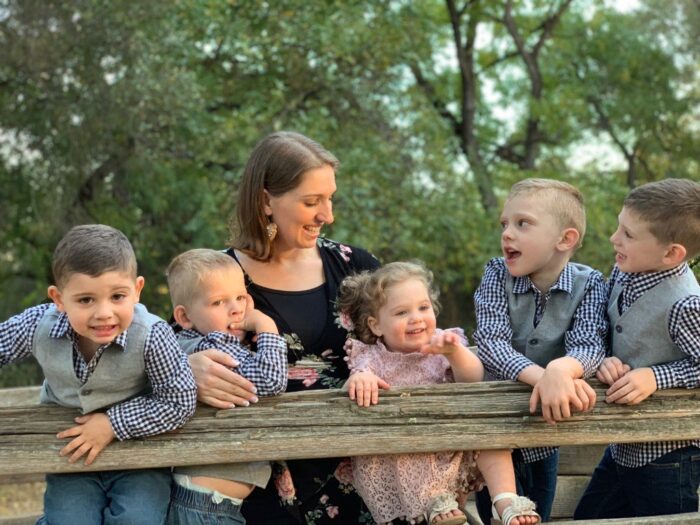
Homemaking is not primarily about completing today’s to-do list. It is about shaping the atmosphere and direction of your home over decades. When you have the big picture in mind, it’s easier to be faitfhful with today’s small load, even if that means trying to learn one new recipe.
Your children are unlikely to remember the messy Tuesday or the burnt casserole. They will remember warmth, stability, laughter, and the quiet faithfulness that marked your days.
You are not behind. You are building something lasting.
If You Want to Grow More Intentionally
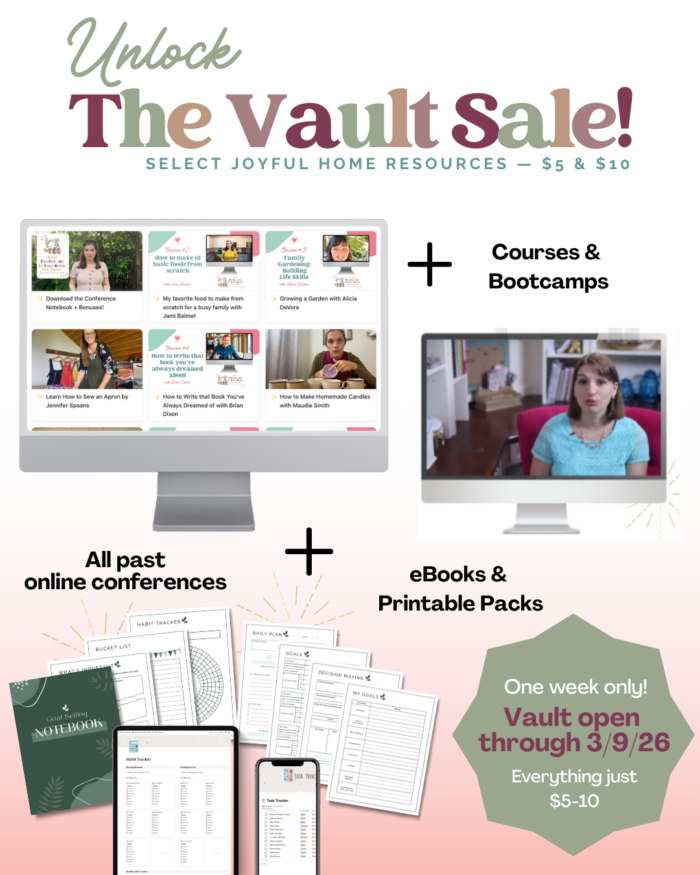
For over twelve years, I have created courses, conferences, planning systems, and digital tools to help women grow in these exact areas — building rhythms, creating home management systems, meal planning consistently, strengthening spiritual disciplines, setting purposeful goals, simplifying health, and reducing overwhelm.
For the first time in two years, our full legacy digital library, the courses, conferences, eBooks, and printable systems that were previously sold individually, is available inside our Vault for lifetime access.
Everything is priced at $5 or $10 (normal price is $19-$99 each!)
Or you can purchase the complete Vault bundle for $99.
–> Check out our vault sale here!
But hurry, this incredibly limited time sale ends Monday, March 9th!
These are the same systems that helped me grow from overwhelmed and inexperienced to steady and intentional. They are not magic solutions, but they are practical tools for real progress.
Whether you choose to explore those resources or simply begin where you are today, remember this:
Growth is slow.
Faithfulness matters.
And you are not behind.
You are growing.